
. . . Question the Establishment
If I had to choose which class was the most colossal waste of time and money, it would be “Jazz History”. Led by an incredibly talented jazz pianist with zero teaching skills, our classes usually played out as follows:
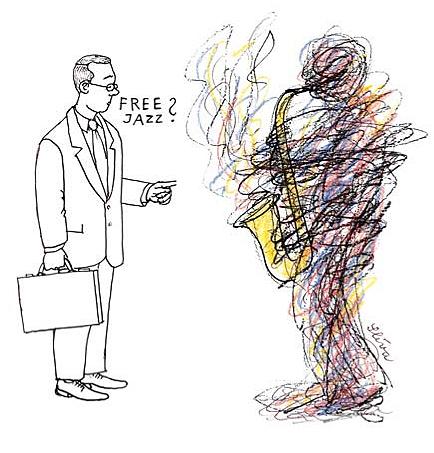
A group of 5-8 students (the class was divided up at the beginning of the semester) would present the information from the chapter we read as homework from the previous week. These presentations lasted anywhere from 15 minutes to the end of time. When my team presented part way through the semester, we took a full 45 minutes since most of the team was incommunicado until right before class started, and we each had thus more or less planned our own individual presentations. My contribution was a description of the style of “Free jazz.” I illustrated with a comic of a musician with chaotic color surrounding his saxophone and a man asking him, “Free jazz?” (see below). This comic struck my professor in a way that only a jazz inside joke could, and he bowled over in laughter, a stark contrast from his nervous, dead-pan expressions. Nailed it, I thought. After the inordinate amount of time of this class presentation, right when I thought we could finally return to our seats, the one group member who had been particularly MIA all week went off script to deliver a spoken word poem. Although it was written and performed with talent and heart, I couldn’t help but look at the clock for the tenth time, our presentation ever-expanding into eternity.
These clown performances were always followed by our instructor standing at the podium, flipping through the pages of the chapter to read aloud all the music and history terminology definitions from the chapter—that we had just defined and described, in detail, with unnecessarily lengthy YouTube videos (and spoken word poems) to accompany our slideshow. After he read us the textbook, we would watch about 20 minutes of more YouTube videos of whatever artists the chapter had covered. Sometimes, if we were so lucky, the instructor would play a jazzy ditty on his keyboard while we tapped our toes to the rhythm.
All quizzes and tests were open-book, open-note, open-partner. If we had been smart, we could have each taken a few questions and just shared the answers with the whole class, saving ourselves an hour. But this class wasn’t built for intelligence or creative communication (that class comes next).
However, we did have a ten-page paper we were assigned to write about a jazz musician of our choice. Even though it was a nonsense assignment—or because it was a nonsense assignment—I really enjoyed writing this paper. I wrote about the all-female jazz bands that toured the nation, most consisting of women of color, many of whom also performed internationally and could both sing and play a long list of instruments—history I had never heard about and have never heard since. This paper earned me, written in over-sized font with a pink highlighter at the top of my paper ten minutes after I turned it in, an A+ GREAT JOB!
I’m sure the International Sweethearts of Rhythm would have been proud.
. . . Question Creativity Itself
Creative: adj. relating to or involving the imagination or original ideas, even if it’s not imaginative or original whatsoever
As I sat in “Anthropology: Creative Communication”, my instructor gave an example of creativity so we plebs could understand: “I was thinking the other day of starting a restaurant that sells chicken, except we’re closed every day except Sunday.” She smiled at us, as if to add, “Ehh? Smart and creative, right?”
All I could think was that was either the worst business plan I’d ever heard or just a joke she had stolen from a stand-up comedy bit. She went on to instruct us to keep a journal of all the “creative” things we did throughout the course of this three-week class. “Order something new at a restaurant. Sing in the shower. Go for a walk somewhere you’ve never been before.” It was apparent this lady was no Steve Jobs.
Over the course of the next few weeks, I wrote down a series of exercises I did to hone this sense of frivolous creativity, and I couldn’t even add the activities I had already engaged in as of late, such as riding my unicycle, turning a saw into a musical instrument, writing stories, or dancing in the living room with my roommates, because those weren’t new to me. I’d already spent my most creative juices sitting in my parked car, trying to keep up with my “Creative Music” teacher as he conducted us to turn on and off our windshield wipers and lights for “Car Symphony”, composed by an alumni who thought he was turning the music industry on its head. And I’d already poured my creative energy into painting a Frida Kahlo unibrow on my face for “Theater Makeup” and writing my feelings in Poetry Club. In fact, the most creative I had the chance to be was in my Creative Writing classes, but those are what got me into this course curriculum mess to begin with.
So, to earn credit for this class I had enrolled in to balance the excess earned in my Creative Writing minor, I read a book on a swing in the park behind my house, making me extremely nauseous as I didn’t factor in motion sickness to the swinging/reading combo. I ordered something different at a restaurant and was slightly disappointed I had wasted my meager college kid funds on a dish I knew I wouldn’t like as much. I did an assortment of other “creative” activities, creatively framing my daily activities as if they were inspirational mayhem.
I think if I had been truly creative, I would have just BS’d the whole list, which is something I was not accustomed to doing. I think in this case the honest thing was the least creative. I wanted to tell this lady that I ate creativity for breakfast! (Which I literally did for the journal, cooking my eggs a different way—gotta get that homework done.)
Our last task for this course was to write a paper on the definition of creativity and how we use it in our majors. Ironically, she graded us strictly on APA style which, after several semesters of forced creativity, was perfectly fine with me.
 Clippings